Sub-Total: $0.00

November 29, 2017
Is The Ball Going Too Far?
“Our longest holes are a little more than a drive and a putt.†……. “If the carrying power of the ball is to be still further increased, all our courses will be irretrievably ruined as a test of the game.â€Â 1
  These very modern sentiments were expressed by USGA president R.H. Robertson in 1902.
In studying this cyclical mantra over the years, it has once again turned up right on cue. There are again rumblings about decreasing the distance the golf ball goes.2
A president of the USGA once said to me, “The fact that there is a perceived problem is in itself a problem.â€Â  As true as this is, the solution is not to solve the perceived problem but the perception.
It may be worthy of note, that no ball being used on the PGA Tour today has failed the Overall Distance Standard (ODS) adopted in 1976 — with some recent updates to the procedure.
We are frequently guilty of treating the ‘extraordinary’ as ‘common-place’. Studies show that when asked how far we drive the ball we inevitably – but subconsciously – respond with an ‘extraordinary’ feat locked in our memories, and choose to ignore reality — i.e. the ‘common-place’ average measurement.3
This is no different than when we observe or hear about ‘extraordinary’ feats by elite golfers on Tour while subconsciously restraining our mind from recognizing that this phenomenal performance is not ‘common-place’, and thus frightens us into doing something mostly because of a fear of the unknown.
Extraordinary and phenomenal performances have been with us for many years.
-
Jack Nicklaus in the early 1960s was able to drive the ball 350 yards using a 42.6-inch persimmon driver and a wound ball.
-
Bobby Jones was the first to reach the 604-yard 16th hole at the Olympic Club in two shots. This was in 1927 with hickory shafted clubs. Bernard Darwin called Bobby’s totally effortless swing “lazy grace†that had you disbelieving the length he achieved at times. 4
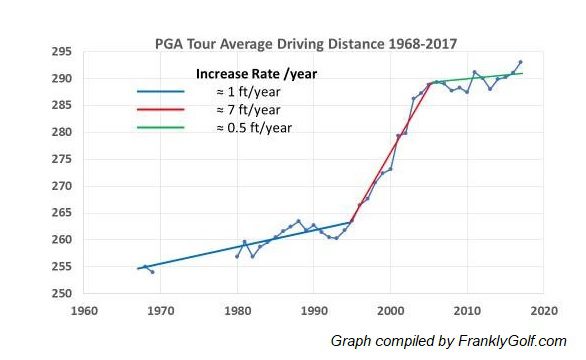
To address the recent and cyclical ‘perception’ that we have a problem, let me present the facts of how the average driving distance on the US PGA Tour – the very best player performance test laboratory — has changed from 1968 to 2017.

Note:
-
With this data before us, we can draw an objective conclusion about the extent, and/or even existence, of a problem.
-
One may note, that in 1995 some titanium drivers, were inadvertently manufactured with a spring-like-effect, followed by the adoption of the COR standard in 1998, despite an existing rule explicitly not permitting, at impact, the effect of a spring.
-
These titanium clubs, in combination with an existing solid two-piece ball —which later would become the multi-layered ProV1 and others — allowed for optimization of launch conditions for specific ball speeds which was not previously possible. This had a significant effect on the increase in distance.
-
The rate of change in driving distance increased by 1.0 ft./yr. between 1968 to 1995. This increased to 7 ft./yr. between 1995 to 2006.
-
This phenomenon is not because of the ball itself as its launch properties off a driver have been available – as a two-piece ball which evolved into a multilayered ball – for many years, and even in its present form has not exceeded the Overall Distance Standard (ODS).
-
The leveling off, to approximately 0.5 ft./yr. from 2006 to 2017 is quite understandable, recognizing that the optimum launch conditions for maximum distance has been achieved by most Tour players.
We need to recognize that the improvement in human performance does have its limits and we are rapidly approaching these. We need to also recognize, that the Laws of Nature are limiting fundamental equipment performance. Knowing this should calm our fears of the unknown, and permit us to focus on those aspects of our game which will enhance the pleasure of playing without diminishing the fundamental challenge which subconsciously attracts us to golf and its purity.
However, if it is somehow determined that there really is a problem — not a perception that there is a problem — which is threatening the very nature of the game, then something must be done and a solution, no worse than the threat itself, must be found.
Bifurcation is not an option as it would negate the 2002 Joint Statement of Principles drawn up by USGA/R&A, which states in part that, “The USGA and the R&A continue to believe that the retention of a single set of rules for all players of the game is one of golf’s greatest strengths.† This belief goes without saying and has been part of the game since its inception.
Over 99% of the golfing population are not obsoleting golf courses and–based on an extensive survey 3— almost all of us are adequately challenged with a golf course of 6200-6300 yards long for men and less than 5,000 yards for women. This has not changed significantly for generations.
It may be better for us to focus on reducing – not increasing — the length of championship golf courses, and strategically setting them up for championship play, so the elite – 0.1% of the golfing population – would be able to exhibit their full range of skills more effectively, which would in turn increase the entertainment value of championships for those of us who aspire to perform as the champions do.
I am confident in saying that few if any golfers have given up the game because they are hitting the ball too far.
For this reason, let us tread lightly to avoid irrevocably impairing the most wonderful self-evaluating game ever devised.
Please weigh in on this important subject as a distance rollback could potentially affect all of us. Share your thoughts by replying below.
Frank
References:
1 “From Sticks and Stones, The Evolution of Golf Equipment Rules†by     Frank Thomas with Valerie Melvin
2 The Wall Street Journal, Golf Weighs Big Shift to Reduced-Distance Golf Balls, November 19 2017.
3Â Growing the Game survey (18,400 responses) FranklyGolf.com
 4 Golf Digest (August 1987), (May 1986)